
Author

Hank Yeomans
Head of Product
Category
Conceal Blog
Published On
Jul 21, 2025
Why Your Security Platform Needs to Live in the Browser
For years, enterprise security has been defined by a flawed choice. On one side, you have the incumbent Secure Service Edge (SSE) providers — the Zscalers, the Palo Alto Networks, the Ciscos. They offer a seemingly comprehensive security stack, but at a steep cost: your traffic must take a mandatory, performance-crushing detour through their cloud proxies. On the other side, a new wave of “Enterprise Browsers” has emerged, rightly focusing on the browser as a critical control point. Yet, they represent an incomplete vision, bolting on generic access solutions as an afterthought and failing to deliver a truly integrated, end-to-end security picture.
This false dichotomy has forced organizations to choose between a slow, intrusive architecture and an incomplete, fragmented one. It’s time to reject the premise entirely. It’s time to ask the question that changes the conversation: Why does your traffic need a detour just to be seen?
The future of enterprise security isn’t a better proxy or a browser stuffed with features. It’s a unified, Browser-native SSE platform that delivers security at the source and provides a direct, high-speed flight path for your data.
The Toll Road to Nowhere: Deconstructing the Legacy SSE Proxy
The fundamental architecture of traditional SSE is rooted in a bygone era of network security. Their entire value proposition — from threat detection to data loss prevention — depends on one thing: forcing all your traffic, including sensitive private application traffic, through their multi-tenant cloud infrastructure. This isn’t just a detour; it’s a toll road with numerous, often hidden, costs.
First, there’s the performance penalty. Every packet of data leaving your user’s device is sent on a roundabout trip to the SSE provider’s point of presence (POP). There, it’s stopped, terminated, decrypted, inspected, re-encrypted, and finally sent on its way. This process introduces significant latency, degrading the user experience for the very applications you’re trying to secure. In a world where every millisecond counts, this is an unacceptable bottleneck.
Second, and far more concerning, is the security risk of mandatory decryption. In order for legacy SSE platforms to gain the visibility they need, they must perform a sophisticated man-in-the-middle operation on your encrypted traffic. You are forced to trust a third party with the keys to your kingdom, allowing them to decrypt your most sensitive internal data. This creates a massive, centralized target for attackers and introduces profound privacy and compliance concerns.
Finally, their visibility is fundamentally flawed. Because their inspection point is far away in a network cloud, they are completely blind to what is happening inside the browser — the true starting point of any modern digital transaction. This is a critical blind spot that sophisticated attackers are eagerly exploiting.
The Blind Spot: Why Enterprise Browsers Are Only Half the Story
Recognizing the visibility gap left by network-centric security, Enterprise Browsers have emerged to bring control directly to the browser. They focus on adding a layer of policy and governance, which is a step in the right direction. However, they treat secure access as a feature, not a foundation.
These offerings focus on what they can stuff into the browser but fail to innovate on how the browser connects out to the world. When it comes to providing Zero Trust Network Access (ZTNA), they typically bolt on an off-the-shelf service, often falling back into the same proxy-based architectures they claim to supersede. They solve one part of the problem while completely ignoring the end-to-end data path. This leaves you with a fragmented solution: a browser with some security features and a separate, often clunky, system for actually connecting to private resources. It’s an incomplete picture that fails to deliver on the promise of a truly seamless and secure experience.
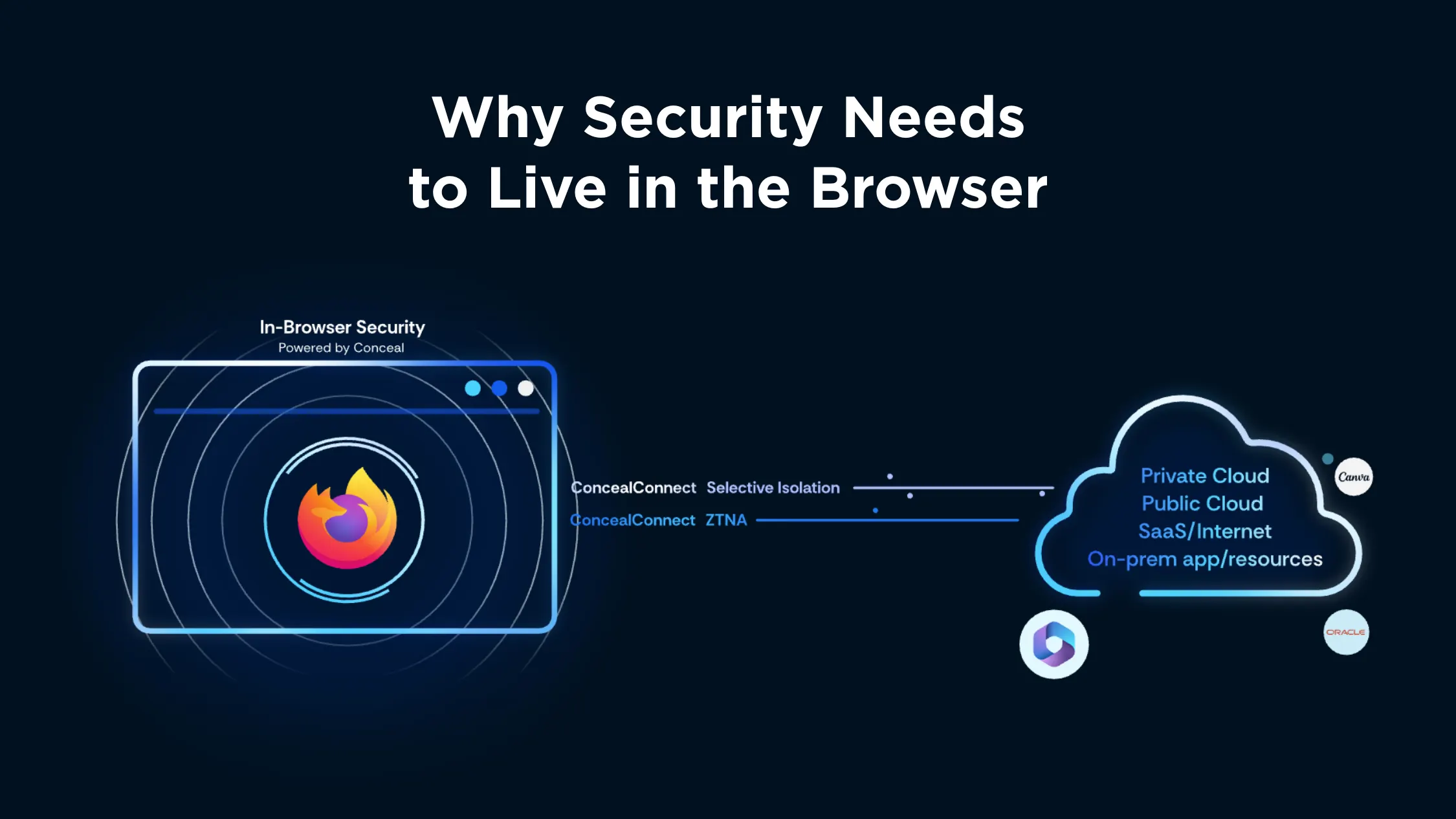
ConcealConnect bridges this chasm by delivering the industry’s first truly Browser-native SSE platform. We fuse the deep, contextual visibility of an advanced browser security solution with a revolutionary, high-speed ZTNA relay service. This creates a single, elegant platform that secures the user from end to end.
1. Security at the Source: A Revolution in Threat Detection
Unlike SSE providers who are blind at the browser, our security starts where the transaction starts. Conceal’s intelligence engine lives within the browser, providing real-time threat detection that is simply impossible for a remote proxy. We don’t just see web requests; we see the very fabric of the web page.
This is critical for stopping modern, evasive threats. Our platform detects and blocks a library of over 80 (and growing) web-based attack signatures. This includes threats designed specifically to fool both users and network-level security:
Adversary-in-the-Middle (AitM): These sophisticated phishing attacks use a proxy to intercept traffic, stealing session cookies to bypass multi-factor authentication. A remote SSE proxy can’t reliably stop this because the initial interaction seems legitimate. Conceal, living in the browser, can identify the malicious rendering and communication patterns in real-time and terminate the threat.
Browser-in-the-Browser (BitB): This attack uses fake browser windows within a real browser tab to create convincing replicas of authentication pop-ups. To a network filter, it’s just pixels on a page. Because Conceal monitors the Document Object Model (DOM), we can detect the creation of these fraudulent, non-standard browser elements and shut them down.
This is the power of a Browser-native SWG, CASB, and DLP. Policy is enforced at the source, providing unmatched security that is both more effective and less intrusive.
2. Fly Direct: The ConcealConnect ZTNA Relay
With security comprehensively handled at the source, the need for a proxy evaporates. This is where we ask, “What proxy?” ConcealConnect provides a groundbreaking ZTNA relay service that uses modern web protocols like MASQUE over QUIC to establish a direct, secure tunnel from the user’s browser straight to the application connector in your on-prem data center or VPC.
Your private application traffic flies direct. There is no detour, no termination, and absolutely no third-party decryption. This results in:
Dramatically Reduced Latency: By eliminating the proxy middleman, we slash latency and provide a superior, more responsive user experience.
Ironclad Security and Privacy: Your traffic remains encrypted from end to end, controlled entirely by you. We eliminate the massive attack surface and privacy risk of forced decryption.
3. Simplicity by Design: Security That’s Easy to Deploy and Manage
A modern security platform should reduce complexity, not add to it. While legacy SSE solutions require complex network re-architecting, policy synchronization, and agent management, the Conceal platform is built for streamlined administration. Deploying our browser-based solution is frictionless for users, and managing policies from a single, intuitive console provides administrators with powerful control without the headache. It is a complete, end-to-end platform that is as simple to manage as it is powerful to use.
The choice is no longer between a slow proxy and an incomplete browser. ConcealConnect offers a new path forward — a single, unified platform that provides unparalleled, real-time threat detection at the source and the fastest, most secure ZTNA access on the market.
Stop buying detours and half-measures. It’s time to fly direct.